
It’s one of the small pleasures in life to put the kettle on and sit down with a cup of tea and a bit of reading, isn’t it?
But I’m guessing you haven’t decided to read an article about shoulder pain for the sheer enjoyment of it.
In fact, if your shoulder is bad enough, the thought of lifting a full kettle of water might actually make you wince!
Shoulder pain can be frustrating because it can feel mysterious. You might be wondering:
Have I damaged the shoulder joint?
Is it a rotator cuff problem?
Is it tendonitis?
Could it be arthritis?
Is it frozen shoulder?
Am I just getting old?
And most importantly… is this ever going to go away?
There are plenty of possible causes of shoulder pain, and sometimes the joint or tendon itself genuinely is the problem.
But don’t worry, there are plenty of ways to ease your shoulder pain and get back to enjoying the small pleasures in life. In this article, we’ll explore some of the most effective techniques used here in the clinic for resolving shoulder joint pain and keeping your body healthy and happy.
If you’ve resorted to conducting your own research, you may feel like you’ve exhausted all possible options. Typically, patients with these problems visit their GP, who may prescribe anti-inflammatory medication, administer a steroid injection, order an MRI scan (which may not show any significant issues), and recommend exercises. When these treatments fail, patients may consider seeing a shoulder specialist as a last resort before undergoing surgery. However, let’s not continue down that path until you read on, shall we?
When Everyday Shoulder Movements Become Painful
Let me introduce you to some sneaky little troublemakers known as ‘Myofascial Trigger Points’. In my experience at the clinic, these Myofascial Trigger Points (think of them as little knots in the muscles) typically develop as a result of an injury to one or more muscles and are often the root cause of shoulder pain. The usual culprits for this pain are the Deltoids at the front and sides of the shoulder (primarily) and the posterior deltoids, Supraspinatus, Teres Major and Teres Minor muscles at the back of shoulder. These Trigger Points, also known as MTrP’s, may have recently developed from trauma (like a fall, tackle, or even dog walking!) or a gym workout. They can also be many years old (I’ve seen 30+ year old ones in some cases!), where they flare up every now and then. If you are experiencing a flare up, you may say to your partner, “Oh no, my problematic shoulder is acting up again! Love, where’s the pain relief gel!?”
You may have already tried a few different types of therapy and were given lots of shoulder rehabilitation exercises to do. You may have done the exercises for a time but realised they weren’t helping and maybe they even flared up the problem.
The problem with stubborn Myofascial Trigger Points, in my clinical experience, is that it’s next to impossible to exercise, strengthen or stretch them away. If you have stubborn Trigger Points in your muscles, I would consider those muscles to be in a ‘dysfunctional’ state. If you set out to strengthen those muscles, and you do a very good job with your strengthening, you will be left with strong dysfunctional muscles! – Jason Kehoe, JK Therapy
That doesn’t mean strengthening is bad. Far from it.
It means timing and assessment matter.
Many people are unaware of the pains and problems caused by muscles with Myofascial Trigger Points (MTrP’s). Unfortunately, even many medical professionals such as therapists, doctors, and consultants are also unaware of the pain MTrP’s can cause. Fortunately, a therapist specializing in Trigger Point Therapy can usually provide a straightforward fix. One characteristic of MTrP’s is that they refer pain to other areas, often to joints and tendons, making them tricky to recognize as the problem may manifest in a different area from where the pain is occurring. MTrP’s are small, feeling like grains of sand or small ball bearings within muscle tissue, making them difficult to treat for therapists without well-developed palpation skills. Since they refer pain along the nerve pathway, MTrP’s can be several feet from where the actual pain is being felt. In the case of shoulder pain, MTrP’s usually occur in one of the muscles mentioned above that connect to the shoulder joint.
What do shoulder trigger points feel like?
People describe them in all sorts of ways. You might have pain and loss of power or feel like something is ‘catching’. You may feel zaps of pain in a particular area of the shoulder, usually the front, as well as a general pain sensation on the outside of the arm. This can occur doing any one of the following movements:
- Pain when lifting your arm
- Loss of power
- A feeling that something is “catching”
- A sharp or sudden zap of pain
- An ache on the outside of the upper arm
- Reduced range of movement
- Pain reaching overhead
- Pain reaching behind your back
Everyday movements that can expose the problem include:
- Lifting a kettle full of water
- Swinging a golf club, tennis racket, Hurley or hockey stick
- Lifting weights overhead
- Doing push-ups or dips
- Putting on a T-shirt or jacket
- Throwing a ball
- Reaching into the back seat of the car
- Scratching your back
- Reaching into a high kitchen press
One of the useful parts of an assessment is finding a movement that reliably produces your pain. That gives us something we can test again after treatment.
Why do these shoulder muscles develop trigger points?
There isn’t always one simple explanation, but three patterns I see repeatedly are trauma, overload and misuse.
Trauma
A fall, tackle, collision, sudden pull or trying to catch something heavy can overload a muscle very quickly.
Sometimes the original incident happened recently.
Other times someone tells me:
“That shoulder has always given me trouble.”
And when we start talking, “always” turns out to mean there was a fall, sporting injury or accident 10 or 20 years ago.
Overload
This is the classic “too much, too soon” problem.
It might be:
- Increasing gym weights too quickly
- Doing far more repetitions than normal
- A long day of DIY
- Repetitive work
- Carrying a child
- New mums (and Dads!) holding a baby or feeding in an awkward position
- Suddenly returning to a sport after a long break
The muscle may simply have been asked to tolerate more load than it was ready for at that time.
Misuse
Sometimes the load isn’t enormous, but you’re repeating an awkward movement hundreds or thousands of times.
Poor desk ergonomics, working overhead, awkward lifting technique or repeatedly moving through the same restricted pattern can all contribute.
CASE STUDY: Golfer couldn’t reach his potential because of shoulder pain
A golfer with a handicap in the high teens walked into my clinic with a nagging shoulder pain that had been bothering him for the last 14 months. His fellow golf club members kept telling him he had great potential to make the club cup teams if he could just get a bit more practice in. To play towards the upper end of amateur golf you generally need to invest in 3-5 rounds a week of practice, that’s a lot of time on the course! I played myself for 20 years before taking up running so I know about its demands.
This patient was limited to playing just once a week because he was in so much pain swinging a club that he could barely play 16 holes before he started stiffening up and feeling pain. He spent the week leading up to the competition stretching and doing band exercises, rubbing on pain relief gel and taking anti inflammatory medication (his GP prescribed) as well as taking some old pain medication after the game he had lying around the house (which his GP didn’t prescribe, definitely not advisable btw!).

During the swing he would brace for the familiar shoulder pain, particularly around impact.
While playing he spent the whole round scanning his body to see when the pain would start. With each swing he braced for a zap of pain. During the backswing he felt a tightness on the outside of his left arm and then on club impact he got a zap of pain in the front of his shoulder when it finally kicked off.
It wasn’t only affecting his golf either.
The kettle and kitchen-press test
This is the type of detail I find particularly useful during an assessment.
He struggled to lift a full kettle.
But his own personal test for his shoulder was his kitchen press. There were three shelves.
On a good day he could just about reach the second shelf. After golf, reaching the first shelf could make him wince and he would often have to use the opposite arm instead.

On a bad day, even reaching up into a kitchen press was enough to bring on his familiar shoulder pain.
Putting on a T-shirt was awkward, his range of movement was restricted and the arm simply didn’t feel powerful.
That’s much more useful information to me than somebody simply saying:
“My shoulder hurts.”
Now I have movements I can test.
What I found during his assessment
I assessed his shoulder movement and was able to reproduce the pain he recognised.
On palpation I found very sensitive areas consistent with trigger points in his:
- Anterior deltoid
- Teres minor
- Supraspinatus
Pressing areas in these particular muscles recreated familiar pain patterns.
That’s what I’m looking for.
If I press an area and somebody immediately says:
“THAT’S the pain!”
…my ears prick up.
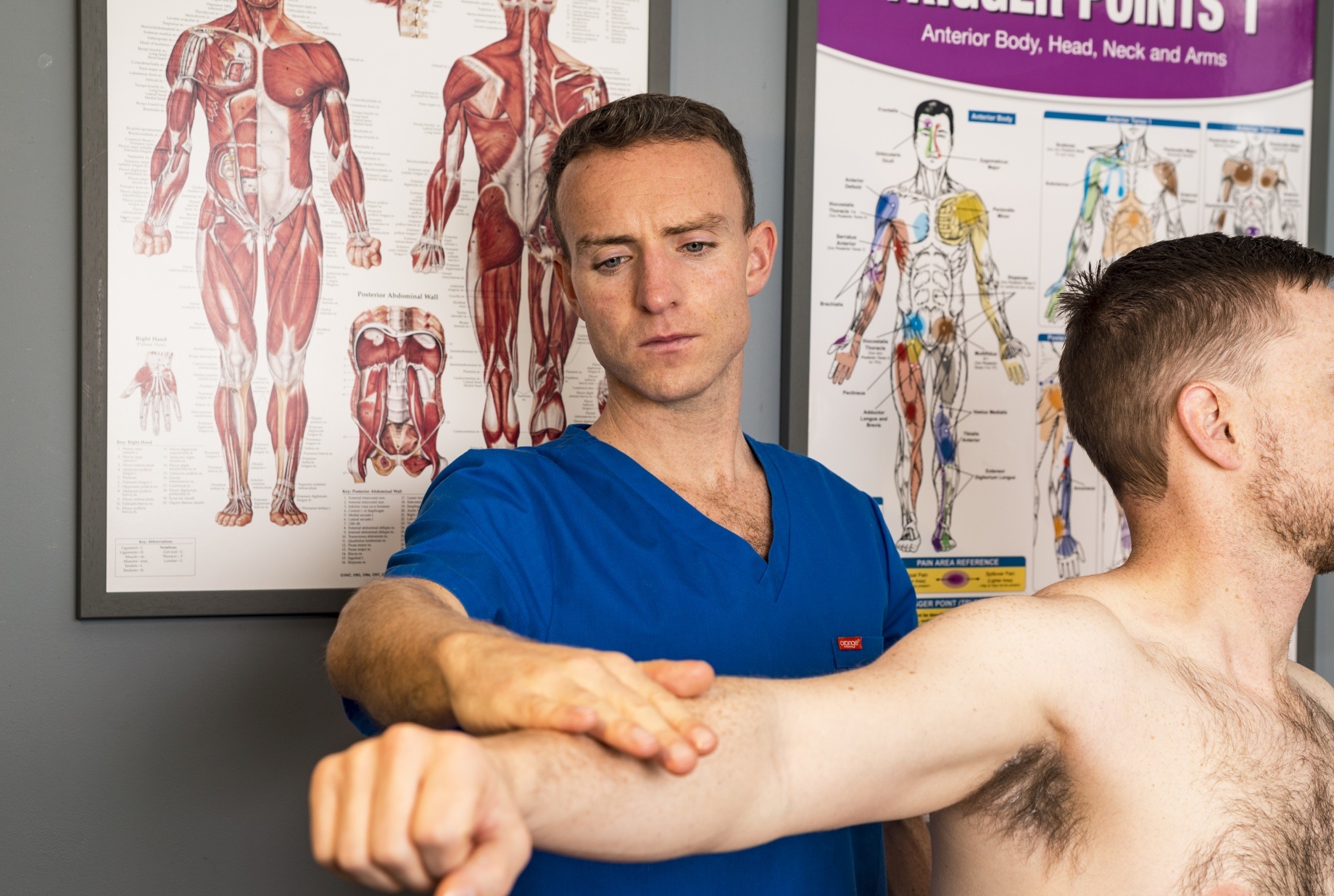
I started with fascia release of the whole shoulder (fascia is like your webbed Spiderman suit beneath your skin) followed by general deep tissue release and some stretching as I went along before doing more specific direct ischemic compression technique to see if I could release some of the less stubborn Trigger Points. This had a positive effect on those painful movements so I knew we were on the correct track.
Finally, we tried Myofascial Trigger Point Dry Needling to hit a dozen or more primary Trigger Points in the Anterior Deltoid, Supraspinatus, and Teres Minor muscles. Although this technique is known as the gold standard for releasing Myofascial Trigger Points, it can be an uncomfortable experience. When the thin acupuncture needle hits a Trigger Point it can provoke a sudden twitch response, a brief reflex contraction that helps reset the abnormal electrical activity in the muscle and allows the tight fibres to relax. Those tight fibres relax and no longer pull on surrounding nerves and the pain goes away almost immediately. The twitch responses of the deltoid muscles can be particularly painful, but it’s worth it to see the near instant results when we test the painful movement again.
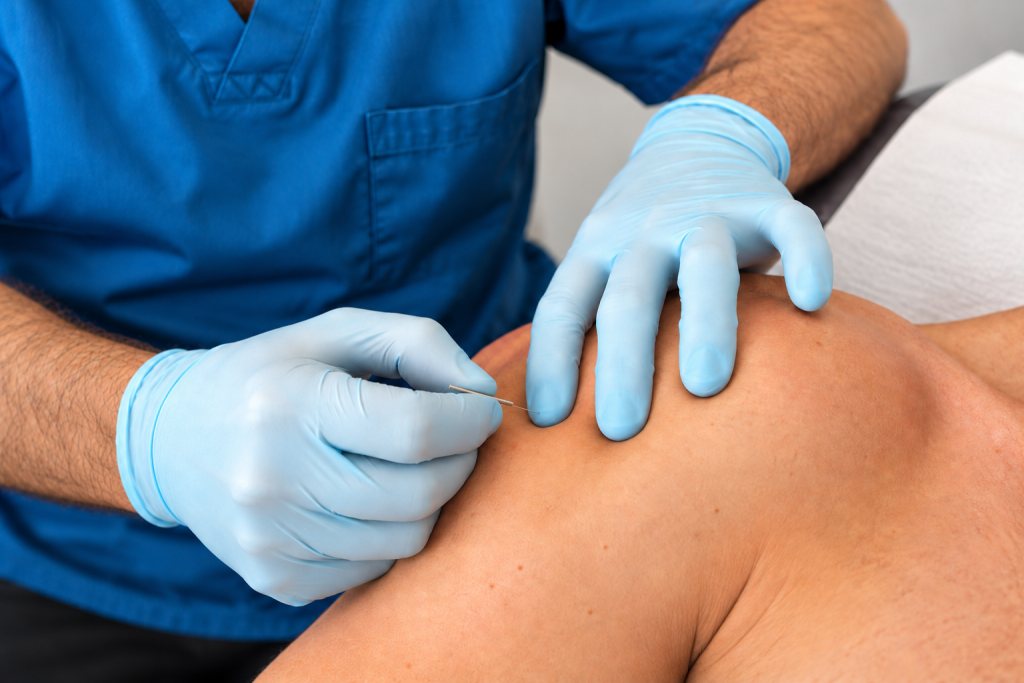
Targeted dry needling treatment of the anterior deltoid and myofascial trigger points.
The anterior deltoid muscle was causing the pain when he lifted anything upwards and the supraspinatus was giving him ‘referred’ pain on the outside of his upper arm. It’s difficult to palpate MTrP’s in the supraspinatus which sits deep in a bony pocket superior to the shoulder blade. I usually dry needle it briefly to see if I can elicit a twitch responses and if I find any then I keep going..and we found a hell of a lot! These referred brief electric like zaps of pain to the outside of the arm when they released. This recreated the pain he felt on the outside of his arm so I knew we were onto a winner. Once the treatment was over, I checked the movements that used to cause him pain. Although there was some tenderness from the dry needling, there was no longer any discomfort or pain. This means that the treatment was successful. Releasing the Trigger Points responsible for the pain usually provides instant relief. Success! He was advised to treat with a thermal heat protocol several times a day which would promote blood flow and muscle repair and then do some light stretching.
Following up with the patient:
We scheduled a second session the following week where he reported an 80% improvement in his pain! He said he was sore after treatment that evening and in the following few days, it felt like someone gave him a few punches in the shoulder. The next morning he was sore and stiff in the treated areas but as the day went on that got easier. By day three it really settled down and on day four he reported he was back to his old self and didn’t experience any of the usual pain he was used to during his ordinary day life.
After assessment we performed a similar treatment again, including the upper trapezius muscles, Pec Major and Infraspinatus muscles. We could now get deeper into the muscles using manual therapy and we cleaned up the remainder MTrP’s using Dry Needling again. He was advised to recover for 5 days and then test it on the golf course. 3 weeks later on a follow up visit he reported no pain during several competitions or at the driving range as well as pain free daily life. My patient was naturally delighted with the result and he booked in for another problem he had with a stiff lower back. Yes you guessed it, more historically old Myofascial Trigger Points, eight years old in fact! He now had a shopping list of ailments which he had just been living with.
Most people are not aware of the pains and problems that muscles which are in trouble are responsible for. What’s worse is that most of the medical community, like your therapist, GP and even your consultant are also unaware of this! It can be a straight forward fix for Neuromuscular Therapists who specialise in Myofascial Trigger Point Therapy.
At JK Therapy Sports & Injury Clinic in Tallaght, Dublin, I work with shoulder and other musculoskeletal problems using a combination of neuromuscular therapy, soft-tissue treatment, Myofascial trigger point therapy, electrotherapy and Trigger Point Dry Needling where appropriate.
The aim isn’t simply to attack the spot that hurts.
It’s to work out why that movement hurts in the first place.
If you’d like me to take a look at your shoulder, you can contact JK Therapy or book an appointment through the website.
Give it a try, you too will likely see an improvement after just one session, just like my patient did!
References and further reading
- Zhao Y, et al. Needling trigger points for treating myofascial pain syndrome: A systematic review and meta-analysis. Complementary Therapies in Clinical Practice. 2025;59:101978.
- Demeco A, et al. Dry Needling in Overhead Athletes with Myofascial Shoulder Pain: A Systematic Review. Sports. 2024;12(6):156.
- Health Service Executive (HSE). Shoulder pain: causes, diagnosis and treatments.
This article provides general information and describes an individual clinical case. It is not a diagnosis or a guarantee that another person’s shoulder pain will respond in the same way.

![Why achilles pain and heel pain can occur in minimalist running shoes [PAIN TREATMENT]](https://jktherapy.ie/wp-content/uploads/2017/10/75-500x383.jpg)
![Fixed – 14 years of shooting pains down legs, welcome to sciatic nerve pain hell! [CASE STUDY]](https://jktherapy.ie/wp-content/uploads/2017/10/23-500x383.jpg)
![How trigger points and bad technique can mess up your knees and running [CASE STUDY]](https://jktherapy.ie/wp-content/uploads/2017/10/dreamstime_xxl_45449783-1-500x383.jpg)
![Hip pain solved in ‘hero’ 75 year old lady [CASE STUDY]](https://jktherapy.ie/wp-content/uploads/2017/11/73-Cropped-e1510667943758-500x383.jpg)



Leave A Comment